Newsletters

Thought Leadership: Maintenance Shutdowns - "Our Conduit to Success"

What is an Electrical Maintenance Shutdown?

An electrical maintenance shutdown refers to a scheduled period where electrical systems are temporarily de-energized to perform essential tasks such as maintenance, inspections, repairs, or upgrades. While the initial thought might be that a shutdown causes inconvenience, an experienced team can make the process seamless.

Why Facility Owners should implement Preventative Maintenance Shutdowns

These shutdowns are critical for maintaining safety, reliability, energy efficiency, and return on investment (ROI) of electrical infrastructure in various industries—ranging from industrial and pharmaceutical plants to commercial buildings and hospitals. Well-executed shutdowns can prevent costly breakdowns, extend the lifespan of equipment, and enhance system performance.

  1. Preventative electrical maintenance shutdowns play a crucial role in ensuring the safety of both personnel and equipment.By regularly adhering to standards such as NFPA 70B which provides guidelines for electrical equipment maintenance, facilities owner can avoid potential hazards preventing equipment failures and worker injuries. The team checks personal protective equipment (PPE) before work begins, and lockout/tagout procedures are followed to de-energize systems, minimizing the risk of electrical shock or arc flash incidents.
  1. The reliability of electrical systems is vital for the smooth operation of any facility.Unplanned downtime due to unexpected electrical failures can disrupt production, cause costly delays, and damage sensitive equipment. Preventative maintenance shutdowns help identify weak points in electrical infrastructure before they fail, ensuring systems operate consistently. Regular maintenance helps avoid the unpredictable, extending the operational life of critical assets and reducing the likelihood of unanticipated failures.
  1. Energy costs and efficiency can be a significant operational expense for any facility.Over time, electrical components such as motors, transformers, and wiring can become less efficient due to wear and tear. Preventative electrical maintenance ensures that these systems are running at optimal performance, minimizing energy waste. Properly maintained equipment uses less energy, reducing consumption, and ultimately leading to cost savings. Regular checks and upgrades also allow facilities to adopt newer, more energy-efficient technologies, further improving overall energy performance.
  1. While the upfront costs of implementing preventative electrical maintenance shutdowns may seem significant, the long-term financial benefits far outweigh them.By preventing costly breakdowns and reducing the need for emergency repairs, facilities can achieve substantial savings. Well-maintained systems also contribute to lower energy costs, fewer repairs, and longer-lasting equipment, resulting in a higher return on investment. Facilities that invest in regular maintenance ensure their electrical infrastructure remains a valuable, cost-effective asset over time.

Preparing for Electrical Maintenance Shutdowns

Proper planning, preparation, and communication are essential to ensure a smooth and successful shutdown. The following steps are critical before initiating any shutdown:

  1. Effective planning is essential for minimizing disruptions setting the foundation of a successful preventative electrical maintenance shutdown. This involves collaborating with stakeholders, determining the optimal shutdown window (typically during off-peak hours), and ensuring the right tools, information, equipment, spare parts and personnel are available.

Before initiating a shutdown, it’s essential to understand the downstream impacts of the electrical systems being serviced.This involves identifying how the shutdown will affect other processes, equipment, and departments within the facility. Communication with all stakeholders—including production teams, IT, safety personnel, and external vendors—is critical to ensure everyone is aligned. Early communication helps manage expectations, allows teams to adjust workflows, and reduces the potential for disruptions. By proactively discussing these impacts, facility owners can ensure that operations continue smoothly during the shutdown period.

A thorough risk assessment and contingency plan is key to identifying potential hazards and challenges that may arise during the shutdown. Facility owners must evaluate the safety risks, such as equipment malfunctions, power surges, or exposure to hazardous materials, and develop mitigation strategies. Additionally, a contingency plan should be in place for a thorough risk assessment including evaluating the condition of equipment, identifying lockout points, and formulating emergency procedures to ensure the safety of all personnel.

  1. Preparation

A visual assessment of critical infrastructure is a vital step in preparing for a preventative electrical maintenance shutdown.This involves inspecting equipment such as breakers, transformers, and panels to identify signs of wear or aging. If equipment is approaching the end of its useful life, it’s essential to have spare parts readily available to avoid unnecessary delays. Having replacement components on hand ensures that repairs or replacements can be made promptly, reducing downtime and preventing further damage to the electrical system. Proactively addressing aging infrastructure helps avoid unplanned failures during the shutdown.

Reviewing previous preventative maintenance records is key to understanding the condition and remaining useful life of critical equipment.By examining the history of maintenance activities and repairs on equipment like breakers, you can determine if any recurring issues exist or if specific parts are nearing the end of their lifecycle. This review helps in prioritizing repairs and identifying potential failures before they disrupt operations. It’s also an opportunity to evaluate whether any equipment needs to be replaced entirely, based on its current condition and performance history.

Validating one-line diagrams and as-built drawings is crucial for ensuring an accurate understanding of the electrical system and its downstream impacts.While we are only as good as the information provided, it is the contractor’s responsibility to perform their due diligence to validate the information provided. Facilities undergo expansions, alterations, renovations and as-builts and panels schedules are not always up-to-date, especially when multiple contractors are performing the work. This can lead to unexpected downstream impact on systems during the shutdown that can have a major impact if unknown.

  1. Clear communication is essential in preparing for a preventative electrical maintenance shutdown.It’s important to notify all stakeholders—such as building management, tenants, and other affected parties—well in advance of the shutdown. A recommended best practice is to provide 48-hour notice and a pre-shutdown meeting to go over processes and responsibilities. Holding a pre-shutdown meeting helps clarify the shutdown process, assign responsibilities, and address any questions or concerns. This level of communication ensures that all parties are aligned and prepared, minimizing disruptions during the shutdown.

Execution of Electrical Maintenance Shutdowns

During the shutdown, tasks such as cleaning, lubricating moving parts, and tightening bolted connections are performed. Specific maintenance tests are conducted for each piece of equipment to ensure optimal performance. For example, methods for maintaining oil-filled transformers differ from those used for medium-voltage disconnects.

Detailed documentation of the performed work is essential, including recommendations for future maintenance. It offers building management a comprehensive record of the activities and serves as a reference for future maintenance.

Opportunities and Value Adds

Maintenance shutdowns give a short window of time for work to be performed to ensure there is little to no time offline for the client. For Martin Electric’s manufacturing Clients - as little as 1 hour offline could lose them millions of dollars in revenue.

  1. Due to our historical knowledge of facilities, we can guarantee a successful shutdown as we can equip ourselves with the correct information, tools, equipment and manpower for the job. Having a consistent contractor performing electrical installations and maintenance allows for continuity in ensuring a successful maintenance shutdown.
  1. Having a highly trained union workforce allows Martin Electric to quickly identify early-stage problems, resulting in major cost savings for our clients. With a large pool of skilled employees who have worked in the same facilities for years, we can turn around shutdowns efficiently, even under tight time constraints.
  1. With a strong reputation of building long-term relationships with clients, this allows us to modernize systems, improve performance, and detect issues early—yielding both short-term savings and long-term efficiency improvements.
  2. The strength of Martin Electric’s relationships with large vendor houseslike HZ Electric Supply Co. and Graybar allows for best price, quality, and time of materials – overall staying on schedule and creating a lasting impact on the facilities we power.

Conclusion

Annual maintenance shutdowns are more than just routine tasks—they are crucial to ensuring the long-term safety, resilience, and efficiency of electrical systems. When executed well, they deliver enhanced operational performance, reduced risk, and increased uptime.

Ready to level up your next maintenance shutdown? Connect with Martin Electric services and let us make the most of your energy and resources together. This email address is being protected from spambots. You need JavaScript enabled to view it.
Thought Leadership 1

Thought Leadership: Preconstruction & Design Assist

Target Value Delivery: Preconstruction & Design Assist

At Martin Electric, we view Design-Assist not simply as a service, but as a smarter approach to project delivery. By engaging early in the process, we help bridge the gap between design intent and real-world execution—bringing practical field insight, coordination expertise, and cost-conscious thinking to the table.

This collaborative model allows us to work alongside the design team and ownership from the outset, ensuring constructability, efficiency, and alignment with project goals. Our involvement supports better-informed decisions, reduces redesign risk, and creates a clearer path to budget and schedule certainty.

Over the years, we’ve refined our Design-Assist capabilities through consistent engagement with complex projects, delivering results that are both technically sound and strategically aligned. What follows is a closer look at how our process supports the client’s vision from concept through construction.

Why go Design-Assist?

Primary engineering and design remain the responsibility of an outside engineering team with the assistance from our team who bring the field experience to the table. Martin Electric will offer review, suggestions, coordination, management and quality control/compliance. We will provide all CADD & BIM details and elevations for electrical rooms, specialty equipment rough-in, and special systems for approval and distribution to other trades.

Target Value Delivery

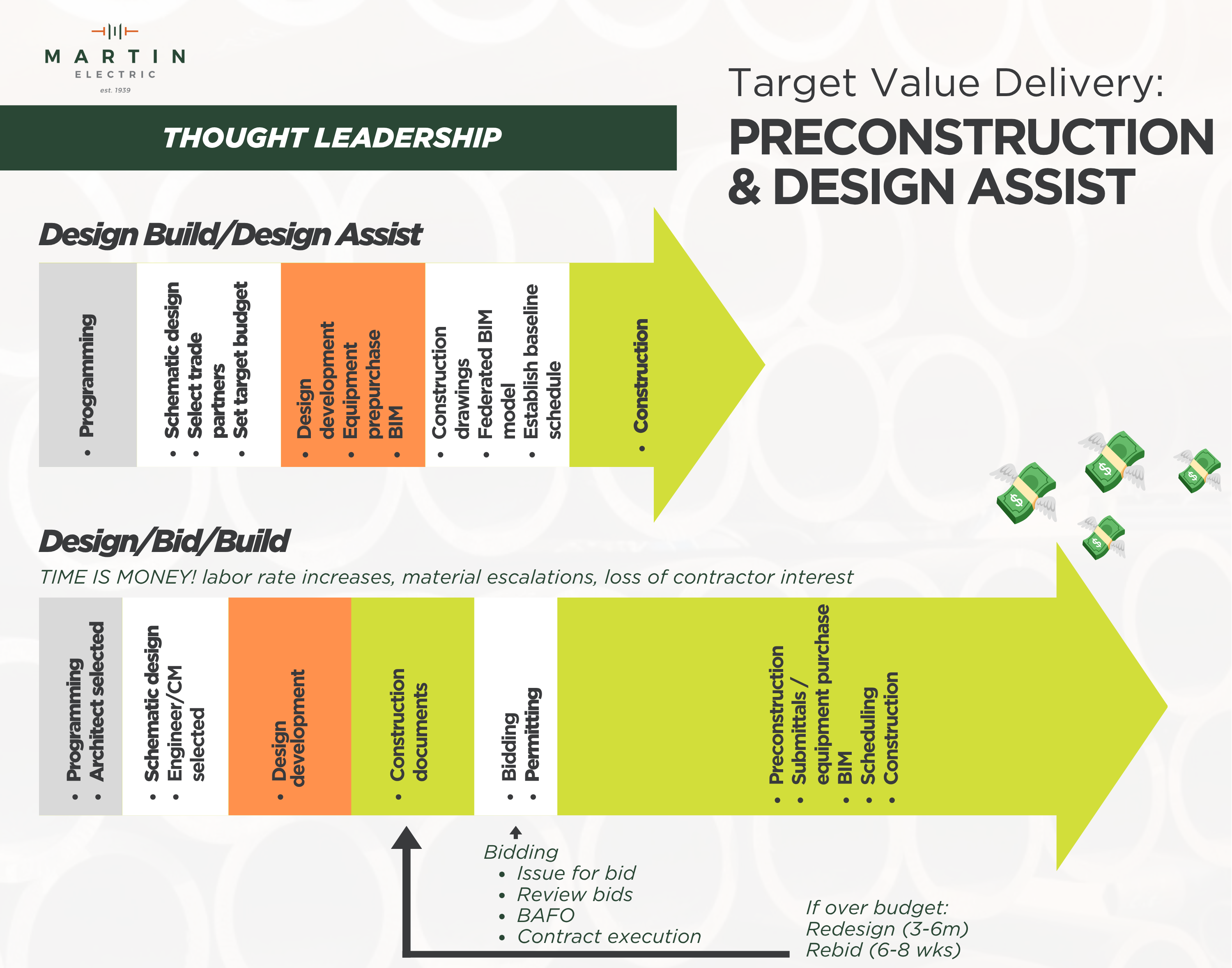
The obvious benefits of this approach are a known budget and maintaining a scheduled start. By setting a budget to design around and providing updated cost estimates. The customer and the designer are assured that when drawings are ready for construction there will not be any surprises.

Traditional design-bid-build methods often result in cost overruns, as designers and end users may not fully grasp the budget implications of specific design choices until the bidding phase. Design-Assist eliminates much of this uncertainty by integrating cost awareness into the design process itself. This minimizes the need for redesigns, re-pricing, and schedule delays, allowing the project to progress more efficiently toward its intended start date.

How does Design-Assist benefit the client?

Early involvement in the design process gives our team a comprehensive understanding of the project, enabling us to offer informed value engineering recommendations and apply proven best practices in construction. This collaborative approach accelerates design development, aligns with a defined budget from the outset, and introduces product alternatives that offer better long-term value.

While Design-Assist may shift more responsibility to the subcontractor, it also allows for greater control over specifications and material selections throughout construction. When executed correctly, this results in fewer design revisions, minimized cost overruns, and reduced schedule disruptions—ultimately supporting a smoother, more predictable project delivery.

Our Design-Assist services include:

  • Provide early review of the specifications and design narrative with appropriate questions and scope clarification
  • Provide analysis of all possible scope gray areas in terms of access, feasibility and risk
  • Provide review of schematic design while offering suggestions and/or comments regarding past history of similar projects
  • Provide potential cost-savings analysis of design and layout of devices
  • Provide early coordination with other trades (mostly mechanical)
  • Provide light fixture specification analysis and alternatives with various manufacturers for review by the engineer, architect and owner
  • Provide detailed layout and dimensions of electrical rooms and panel locations
  • Provide trade coordination and overlay drawings for all critical areas with power and special systems
  • Provide coordination with owners and owner consultants for all specialty equipment
  • Provide as-built drawings while maintaining updated sets throughout the project

Our Design-Assist Portfolio:

  • Regeneron
  • Plug Power
  • MetLife
  • Verizon
  • Rensselaer County 1600 Building
  • Rensselaer County 99 Troy Road

If you are interested in working with Martin Electric on a Design-Assist project, please contact Olivia Bradt; Business Development Manager at This email address is being protected from spambots. You need JavaScript enabled to view it.

June Thought Leadership Graphic

Thought Leadership: Prefabrication

Learning & Standardizing

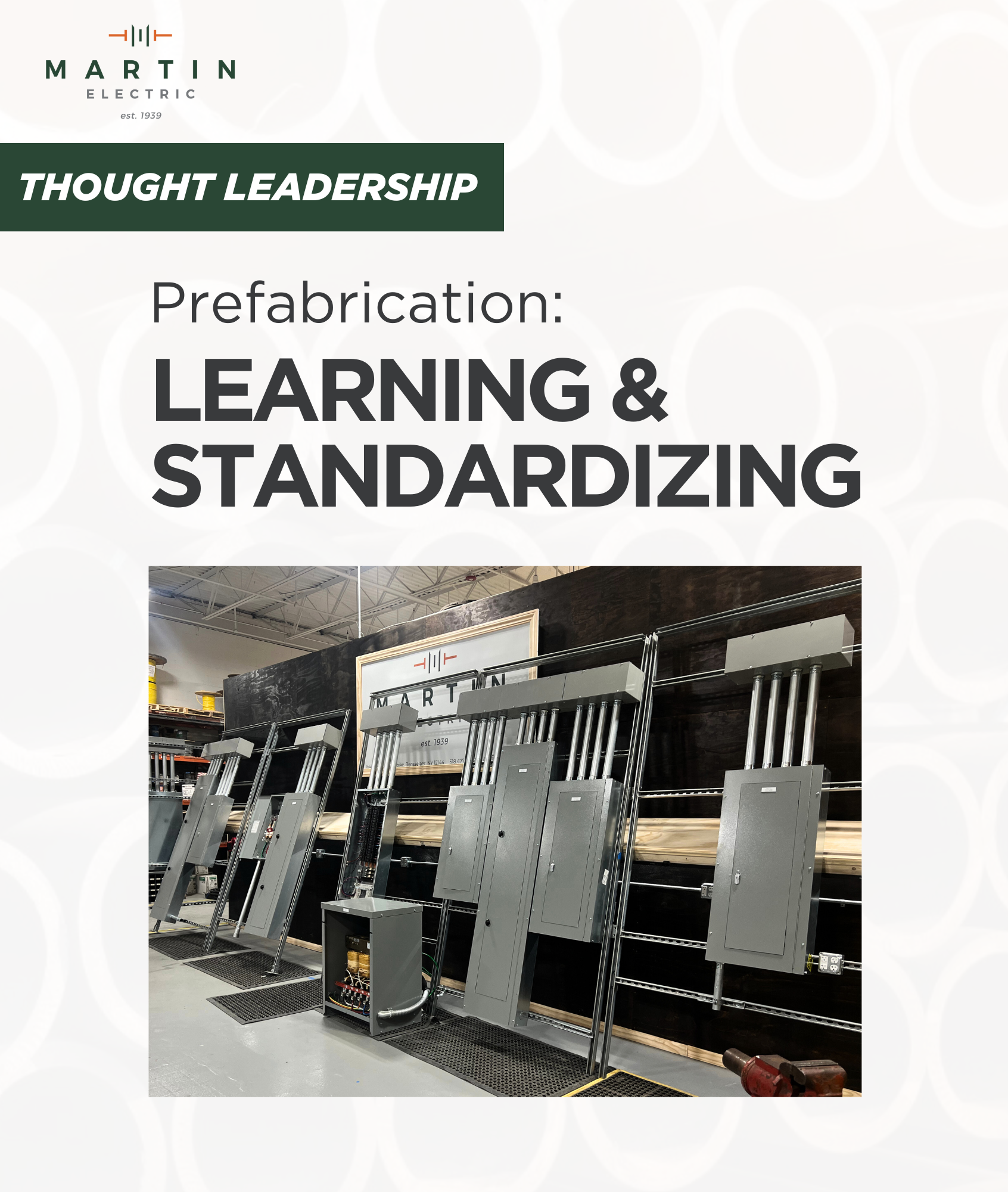
When it comes to prefabrication, the journey can sometimes be painful. A few years ago we attempted our first underground racked feeder conduit system for our Client. While we ultimately produced the assembly, it came with a significant amount of waste, frustration and lessons learned. From increased hours in fabrication to inaccurate layout of foundation openings, the prefabrication did not yield the efficiency, accuracy or quality we had anticipated. We took a hard look at our process and asked ourselves—was prefabrication really the right direction? The answer came through loud and clear: our team was ready to learn from the experience, commit to standardizing our approach, and turn this challenge into a long-term strength.

Here are the 5 key steps we took to refine our prefabrication process:

#1 Identify a Champion

This goes without question for any initiative you are looking to take on. Without a Champion, you can guarantee the initiative will fail or more likely, never even take off. The Champion should be equal parts knowledgeable in the scope of work and passionate about the mission. Once we had a project Champion, we developed a committee consisting of other key process stakeholders responsible for the PDCA cycle.

#2 Research & Development 

Thanks to many of our trade partners and even some of our competitors, we toured prefabrication shops across the Northeast and had the opportunity to speak with those managers about their process & lessons learned. Not only were these companies willing to open their shops to us but some even shared their SOP’s. Across the board, each shop stressed the importance of:

  • Standardizing the process
  • Getting everything to hit fab floor on wheels

After our field research, our committee developed a project charter which consisted of Purpose, Goals, Target Date, Milestone Schedules, Roles & Responsibilities, and Conditions of Satisfaction. This became our guiding light throughout the process. Some other key strategy sessions we conducted to help us identify and achieve our desired future state included A3 Problem Solving and Value Stream Mapping.

#3 5S'd our Warehouse 

Through our R&D, we determined that our Achilles heel was the lack of organization and standardization of our warehouse. This resulted in a significant amount of waste in our prefabrication process. The biggest waste being MOTION. Upon evaluation, we noticed multiple trips across the floor to pick or search for material along with multiple set-up and break downs of our fab equipment (benders, threaders, saws). Additionally, nothing was on wheels making any sort of movement take that much longer.

To help us achieve the desired future state, we utilized the 5S lean systems thinking. 5S refers to a methodology that stands for “Sort, Set in Order, Shine, Standardize, and Sustain,” which is a system for organizing and maintaining a clean, efficient workspace by eliminating unnecessary items, clearly defining where everything should be, and establishing routines for daily cleaning and upkeep, ultimately aiming to reduce waste and improve productivity.

To learn more about how we 5S'd our warehouse, check out thisarticle!

#4 Standardize

One of our Conditions of Satisfaction for this initiative was to have a working Standard Operating Procedure for our Prefabrication process. An SOP allows for consistency in how fabrication is executed to create an easily, repeatable process across different projects and teams. A key tool we used in developing our SOP, was value stream mapping. VSM aids standardization by visually depicting the entire process flow, allowing teams to identify variations in how tasks are performed across different departments or operators, which then enables them to pinpoint areas where processes need to be standardized to eliminate inconsistencies and improve overall efficiency; essentially, by visualizing the current state, it highlights where deviations from a standard practice occur, facilitating the implementation of consistent procedures across the organization.  

With these processes firmly in place, we had the opportunity to apply them on a current high-profile project. Drawing from the lessons learned and experience gained through earlier challenges, we successfully prefabricated the majority of our scope directly in our warehouse—well before our field crew ever set foot on site. This not only streamlined our installation but also validated the impact of our continuous improvement efforts.

#5 Mindset

Prefabrication is not a one-and-done solution; it’s an ongoing process that requires dedication and adaptability. Each project presents its own set of challenges, and the key is to remain committed to the journey of improvement. Instead of giving up when things get tough, we’ve learned to take a step back, reassess our strategies, and implement changes that lead to better outcomes.

So, to anyone out there grappling with the challenges of prefabrication: don’t quit. Embrace the pain, refine your processes, and remain open to innovation. As we know, this is an ever-evolving industry!

Thought Leadership 13