Newsletters
Thought Leadership: Innovation Through AI
Innovation Through AI: 3D Printing & Control Programming
“While construction firms can do little about evolving tariff and trade policies, they do have options to deal with the high attrition rates and labor shortages in construction and design that only compound the problem. In the built environment, AI can slash time spent on repetitive tasks, improve management and material efficiency, augment design teams and improve productivity.” – Forbes, Solving Construction’s Labor Shortages with AI.
In the construction world, change tends to arrive in steel-toed boots. It’s slow, it’s skeptical—and often for good reason. But at Martin Electric, we’ve seen firsthand what happens when innovation isn’t top-down—it’s hands-on. And no one embodies that better than Fred Warden, our project manager and resident innovator.
Some people think 33 years of experience would make you rigid, but Fred doesn’t just embrace new technology—he plays with it, tests it, breaks it, and finds ways to use it in the field where it matters most. Over the last few years, he’s turned his personal passion for AI and 3D printing into a set of practical tools that are transforming how we deliver work for clients.
Built for Builders: AI in the Office
AI is helping us accelerate—not replace—key planning tasks. Here’s what that looks like in practice:
- Blueprint Pre-Markups: Fred uses AI to generate initial electrical drawing markups before they even hit Procore. The result? Faster review cycles and more time spent refining, not redlining.
- Spec Comparisons: Fred has helped other project engineers to implement AI into their practices where it works. One project engineer uses it to compare schematic design (SD) and design development (DD) specs, flagging late-stage changes.
- Contract Abstracts: We’ve recently created a contract abstract for a client using AI—automating the time-consuming review process and making sure the critical details were front and center.
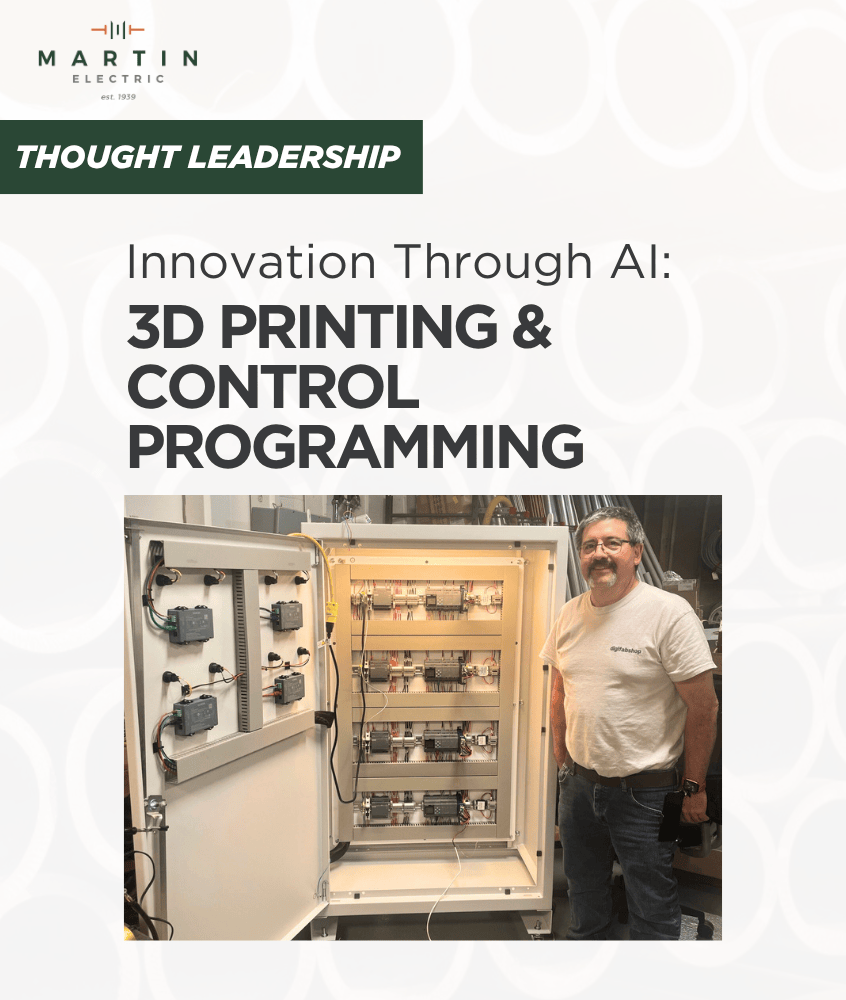
- Controller Coding: On a recent project, Fred used AI to write a control system for two A.O. Smith commercial water heaters, operating from a single Honeywell aquastat and managed by a Siemens LOGO! controller. After AI built the backbone, Fred fine-tuned the logic himself—adding safety interlocks, lead/lag alternation, pump run-on timers, and a full diagnostics display.
AI handles repetitive structured tasks, Fred layers on experience, The result is a hybrid AI-human design.
What have we found works best? Although not specifically built for construction, we have found Claude AI to be a great platform for our use.
3D Printing: Custom Components On Demand
Where we’ve seen the biggest impact from 3D printing is in the building phase—particularly with control panels and fixture mounting. Before, we relied on off-the-shelf parts or manual fabrication for brackets, jigs, spacers, and clips. That meant delays, rework, and inconsistency.
Now? We have the ability to design and print exactly what we need:
- Custom Jigs to speed up and standardize installation in the field
- Precision Spacers to mount components at exact distances, eliminating guess work and rework
- Specialty Brackets and Clips for a cleaner, more reliable fixture mounting
- Control Panel Components built to spec in-house, reducing lead time and improving quality
We're no longer waiting for shipments or modifying stock parts—we're building smarter, faster, and with more control over the end result.
Lessons Learned from Fred
What makes this work isn’t just the tools. It’s the people who use them. Fred’s interests in AI and 3D printing didn’t start as a company initiative. It started because he wanted to solve problems better. We gave him the space and freedom to experiment. He didn’t wait for someone to tell him what AI was good for. He figured it out. Then he shared what he learned.
Here are three takeaways we’ve learned from watching him work:
- Start with the pain point—not the product. Fred didn’t start with “we should use AI.” He started with “how can I speed up blueprint prep or control logic?” That’s where innovation lives.
- Tools amplify talent. AI and 3D printing don’t replace skilled tradespeople—they elevate them. It’s not automation vs. electricians. It’s electricians + smarter tools.
- Build what you need. When you can create custom components on demand, you remove layers of inefficiency. You get better results—and fewer surprises.
We believe the next generation of construction will be defined by intelligent building: smarter planning, custom components, and tighter integration between engineering and execution. Thanks to innovators like Fred Warden, we’re not waiting for the industry to catch up - we’re already there.
Curious where to start? Don’t wait for a mandate. Start small. Find one recurring frustration. Try a new tool. See what changes.