Newsletters
Thought Leadership: Prefabrication
Learning & Standardizing
When it comes to prefabrication, the journey can sometimes be painful. A few years ago we attempted our first underground racked feeder conduit system for our Client. While we ultimately produced the assembly, it came with a significant amount of waste, frustration and lessons learned. From increased hours in fabrication to inaccurate layout of foundation openings, the prefabrication did not yield the efficiency, accuracy or quality we had anticipated. We took a hard look at our process and asked ourselves—was prefabrication really the right direction? The answer came through loud and clear: our team was ready to learn from the experience, commit to standardizing our approach, and turn this challenge into a long-term strength.
Here are the 5 key steps we took to refine our prefabrication process:
#1 Identify a Champion
This goes without question for any initiative you are looking to take on. Without a Champion, you can guarantee the initiative will fail or more likely, never even take off. The Champion should be equal parts knowledgeable in the scope of work and passionate about the mission. Once we had a project Champion, we developed a committee consisting of other key process stakeholders responsible for the PDCA cycle.
#2 Research & Development
Thanks to many of our trade partners and even some of our competitors, we toured prefabrication shops across the Northeast and had the opportunity to speak with those managers about their process & lessons learned. Not only were these companies willing to open their shops to us but some even shared their SOP’s. Across the board, each shop stressed the importance of:
- Standardizing the process
- Getting everything to hit fab floor on wheels
After our field research, our committee developed a project charter which consisted of Purpose, Goals, Target Date, Milestone Schedules, Roles & Responsibilities, and Conditions of Satisfaction. This became our guiding light throughout the process. Some other key strategy sessions we conducted to help us identify and achieve our desired future state included A3 Problem Solving and Value Stream Mapping.
#3 5S'd our Warehouse
Through our R&D, we determined that our Achilles heel was the lack of organization and standardization of our warehouse. This resulted in a significant amount of waste in our prefabrication process. The biggest waste being MOTION. Upon evaluation, we noticed multiple trips across the floor to pick or search for material along with multiple set-up and break downs of our fab equipment (benders, threaders, saws). Additionally, nothing was on wheels making any sort of movement take that much longer.
To help us achieve the desired future state, we utilized the 5S lean systems thinking. 5S refers to a methodology that stands for “Sort, Set in Order, Shine, Standardize, and Sustain,” which is a system for organizing and maintaining a clean, efficient workspace by eliminating unnecessary items, clearly defining where everything should be, and establishing routines for daily cleaning and upkeep, ultimately aiming to reduce waste and improve productivity.
To learn more about how we 5S'd our warehouse, check out this article!
#4 Standardize
One of our Conditions of Satisfaction for this initiative was to have a working Standard Operating Procedure for our Prefabrication process. An SOP allows for consistency in how fabrication is executed to create an easily, repeatable process across different projects and teams. A key tool we used in developing our SOP, was value stream mapping. VSM aids standardization by visually depicting the entire process flow, allowing teams to identify variations in how tasks are performed across different departments or operators, which then enables them to pinpoint areas where processes need to be standardized to eliminate inconsistencies and improve overall efficiency; essentially, by visualizing the current state, it highlights where deviations from a standard practice occur, facilitating the implementation of consistent procedures across the organization.
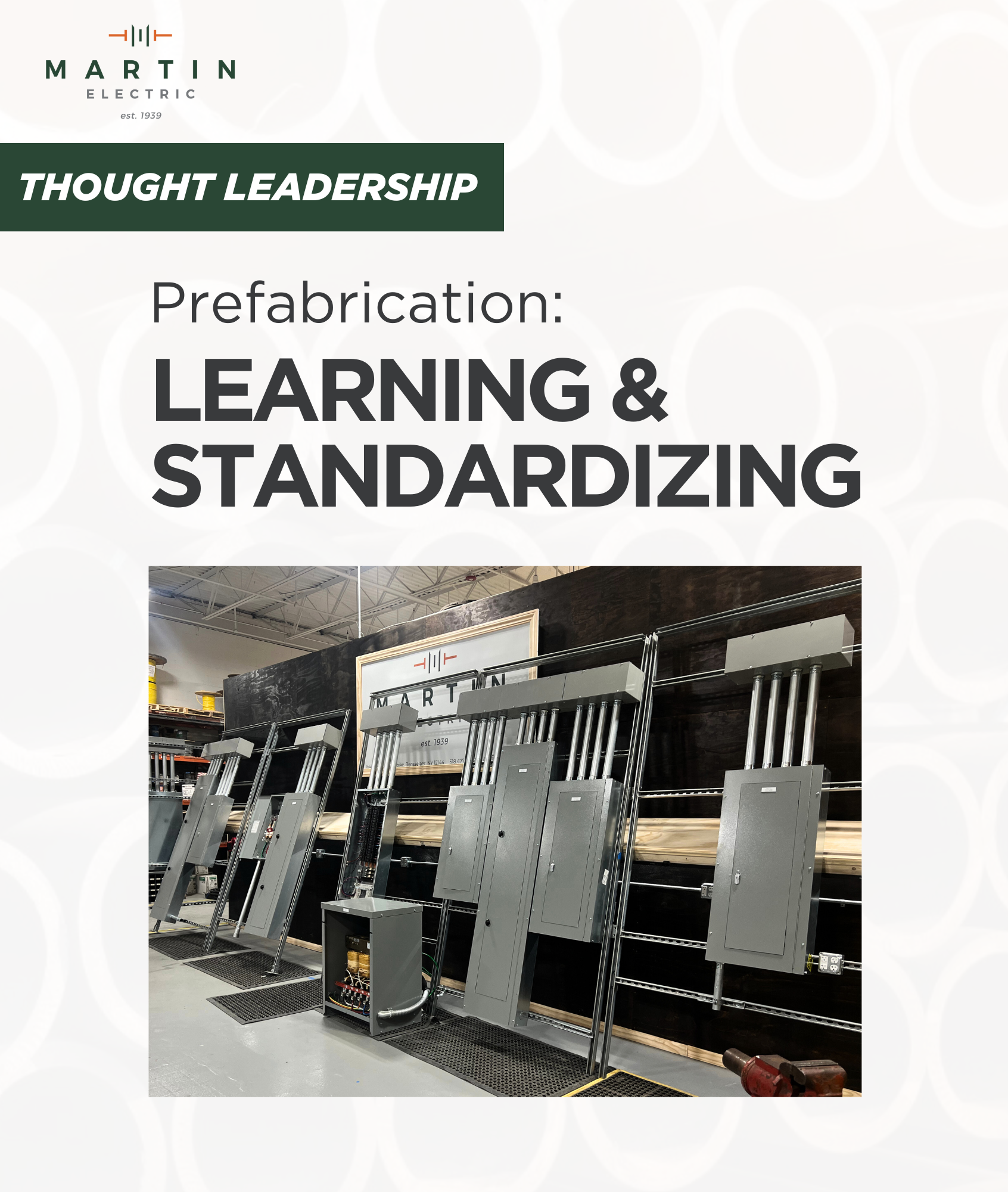
With these processes firmly in place, we had the opportunity to apply them on a current high-profile project. Drawing from the lessons learned and experience gained through earlier challenges, we successfully prefabricated the majority of our scope directly in our warehouse—well before our field crew ever set foot on site. This not only streamlined our installation but also validated the impact of our continuous improvement efforts.
#5 Mindset
Prefabrication is not a one-and-done solution; it’s an ongoing process that requires dedication and adaptability. Each project presents its own set of challenges, and the key is to remain committed to the journey of improvement. Instead of giving up when things get tough, we’ve learned to take a step back, reassess our strategies, and implement changes that lead to better outcomes.
So, to anyone out there grappling with the challenges of prefabrication: don’t quit. Embrace the pain, refine your processes, and remain open to innovation. As we know, this is an ever-evolving industry!